Immigration
Written by : Rohit Alluri
Applying for an Australia Partner Visa in 2026? How to Avoid Refusal and Get Approved Faste
Every year, hundreds of partner‑visa applications are delayed or refused because of avoidable mistakes in timing, documents, and consistency. In 2026, the Department of Home Affairs expects decision‑ready files from day one — and if your evidence doesn’t match, your relationship can be questioned.
If you’re applying for a Subclass 820/801 (Onshore) or Subclass 309/100 (Offshore) visa this year, here is everything you need to know to ensure your application is airtight.
If you are in a genuine relationship with an Australian citizen, permanent resident, or eligible New Zealand citizen, the Australia Partner Visa allows you to live, work, and build your future together in Australia.
There are two pathways depending on where you currently live:
Subclass 820/801 — Onshore Partner Visa
This is for applicants who are already living inside Australia. You first receive a temporary visa (Subclass 820), and once your relationship is verified — usually after two years — it converts to a permanent visa (Subclass 801).
This is for applicants applying from outside Australia, such as from India. You are first granted a temporary visa (Subclass 309) to move to Australia, which later becomes permanent (Subclass 100).
The "Decision-Ready" Standard: Why 2026 Is Different
In 2026, the quality of your initial submission is the single most important factor in your visa journey. Home Affairs has made it clear: applications with missing documents or incorrect information face significant delays and a higher risk of immediate refusal.
Why the change? The Department is focused on clearing backlogs. A complete file allows a case officer to make a decision without issuing a "Request for Information" (RFI), which can add months to your wait time.
While the four pillars of evidence—Financial, Social, Household, and Commitment—remain the foundation, the 2026 update emphasizes current and consistent proof.
Evidence Category | What You Must Prove in 2026 |
Financial | Joint bills, loans, shared shopping receipts (not just bank statements). |
Social | Photos together, event invites, Form 888 from family/friends. |
Household | Shared domestic life (leases, mail to both, shared child responsibilities). |
Commitment | Long-term future (wills, superannuation beneficiaries, detailed statements). |
Common Mistakes That Trigger Refusals (The Consistency Trap)
One of the biggest reasons for visa stress is inconsistency.For instance, if your relationship statement says you moved in together in June 2023, but your lease agreement starts in August 2023, case officers may doubt the genuineness of the relationship
Critical details that must match across all forms:
- Relationship dates: (anniversaries, move‑in dates, engagement dates)
- Address History: (matches on both applicant and sponsor forms).
- Sponsor Details: (sponsorship and character checks must be current and consistent)
Organizing Your ImmiAccount the Right Way
In 2026, how you present your documents is almost as important as the documents themselves. A messy ImmiAccount upload can lead to confusion and delays.
- Label Everything Clearly: Instead of "jpg," format, use "pdf."
- Group Your Evidence: Use folders or merged PDFs for specific categories (e.g., "Social Evidence – Photos and Travel").
- Avoid Duplicates: Cluttering your file with the same document multiple times makes the case officer's job harder.
As of early 2026, the Department of Home Affairs reports that 50% of temporary partner visa (Subclass 820/309) applications are processed within around 17 months.
A well-organized, complete application is the best way to stay on the shorter end of that processing window.
Keeping Your Application Updated After Lodgement
Your application isn't "set and forget." If you move house, get married, or have a child while your visa is being processed, you must update the Department via ImmiAccount. Failure to report changes in circumstances can lead to complications or even visa cancellation later on.
Final Thoughts: Don't Leave Your Future to Chance
Navigating the Australian Partner Visa process in 2026 is more than just filling out forms—it’s about building a legal bridge for your life together. With the Department of Home Affairs moving firmly toward a “decision‑ready” approach, there is almost no margin for error. One missing document or a single date inconsistency can delay your application, extend separation, or even lead to refusal.
At LEAMSS, we do more than complete your forms. We build a strong, evidence‑based case around your unique relationship, while strictly following all visa rules—so you apply correctly the very first time.
(FAQs)Australia Partner Visa in 2026 :-
Q.1 How much does an Australia partner visa cost in 2026?
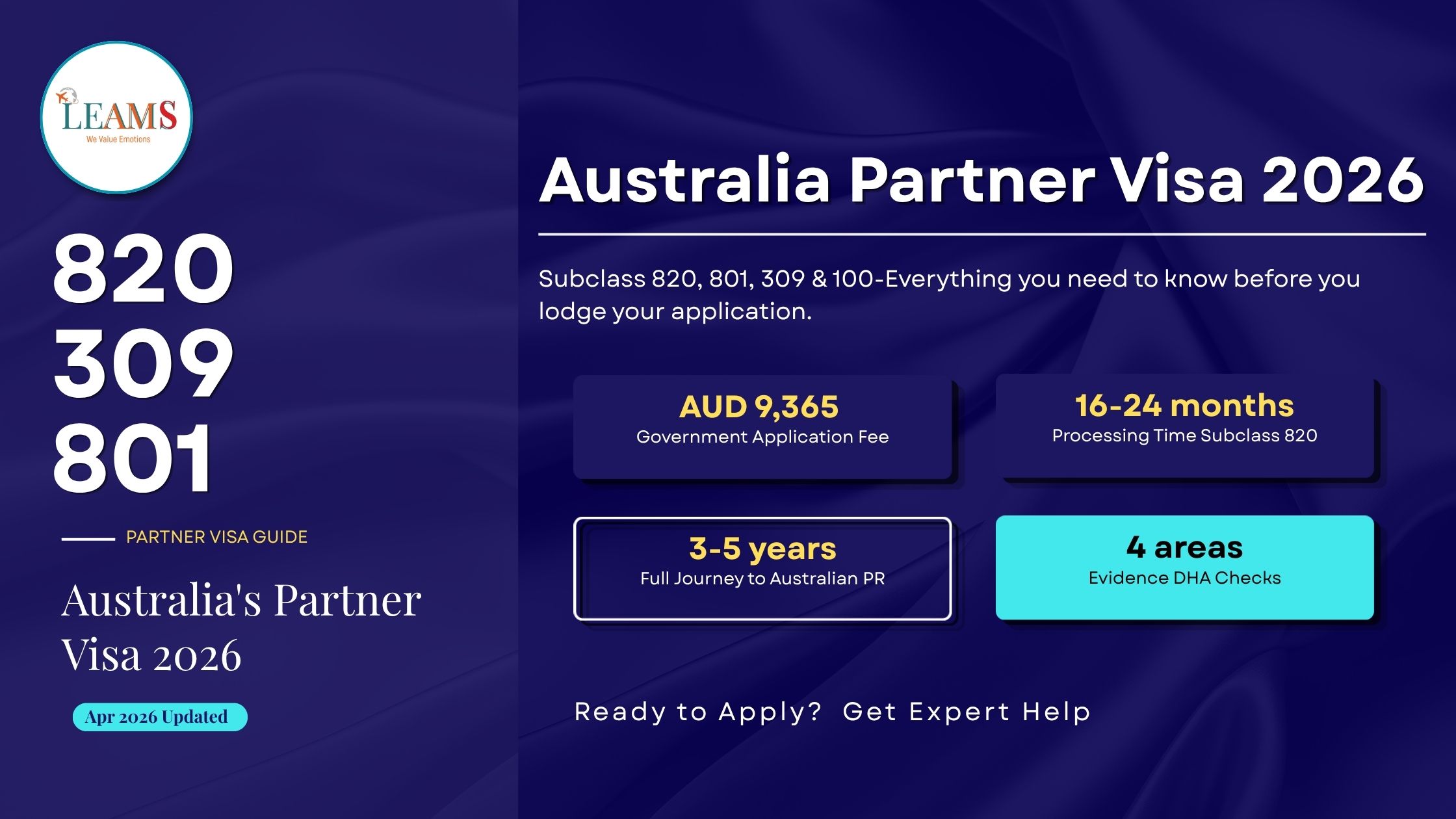
As of the 2025‑26 financial year, the base visa application charge for an Australia Partner Visa (Subclasses 820/801 or 309/100) is AUD 9,365, plus additional fees for dependents, health checks, police clearances, and biometrics.
Q.2 What is the current processing time for an Australia Partner Visa in 2026?
As of early 2026, the Department of Home Affairs reports that 50% of Subclass 820 (Onshore) and 309 (Offshore) applications are processed within 14–17 months. However, "decision-ready" applications—those submitted with all police checks, medicals, and complete evidence—are often finalized significantly faster, sometimes within 8–10 months.
Q.3 Can I work on a partner visa in Australia in 2026?
Yes, you can work on a partner visa in 2026. Both temporary (820/309) and permanent (801/100) partner visas provide full work rights, allowing you to work for any employer in any field.
Q.4 What is the main reason for Australia partner visa refusal?
The most common reason for refusal is lack of evidence or inconsistent information. If your dates, addresses, or stories don’t match across your forms and statements, the Department may not be satisfied that the relationship is genuine.
Q.5 Do I need an English test for a Partner Visa in 2026?
For the temporary stage (820 or 309), there is no English language requirement. However, for the permanent stage (801 or 100), the government encourages "functional English." In 2026, there are more flexible testing options (like PTE) to help you meet this standard if required.
Ready to start your Australia journey in 2026?
Let’s make sure your partner visa application is decision‑ready from day one. Contact our expert team today for a comprehensive eligibility assessment and a clear roadmap for your 2026 lodgement.
Speak Directly with our Expert:
Lead Consultant: Rohit Paul Alluri
WhatsApp: +91 77383 52427
Email Us: ladhani@leamss.com
Visit Our Website: www.leamss.com

 Back to Home