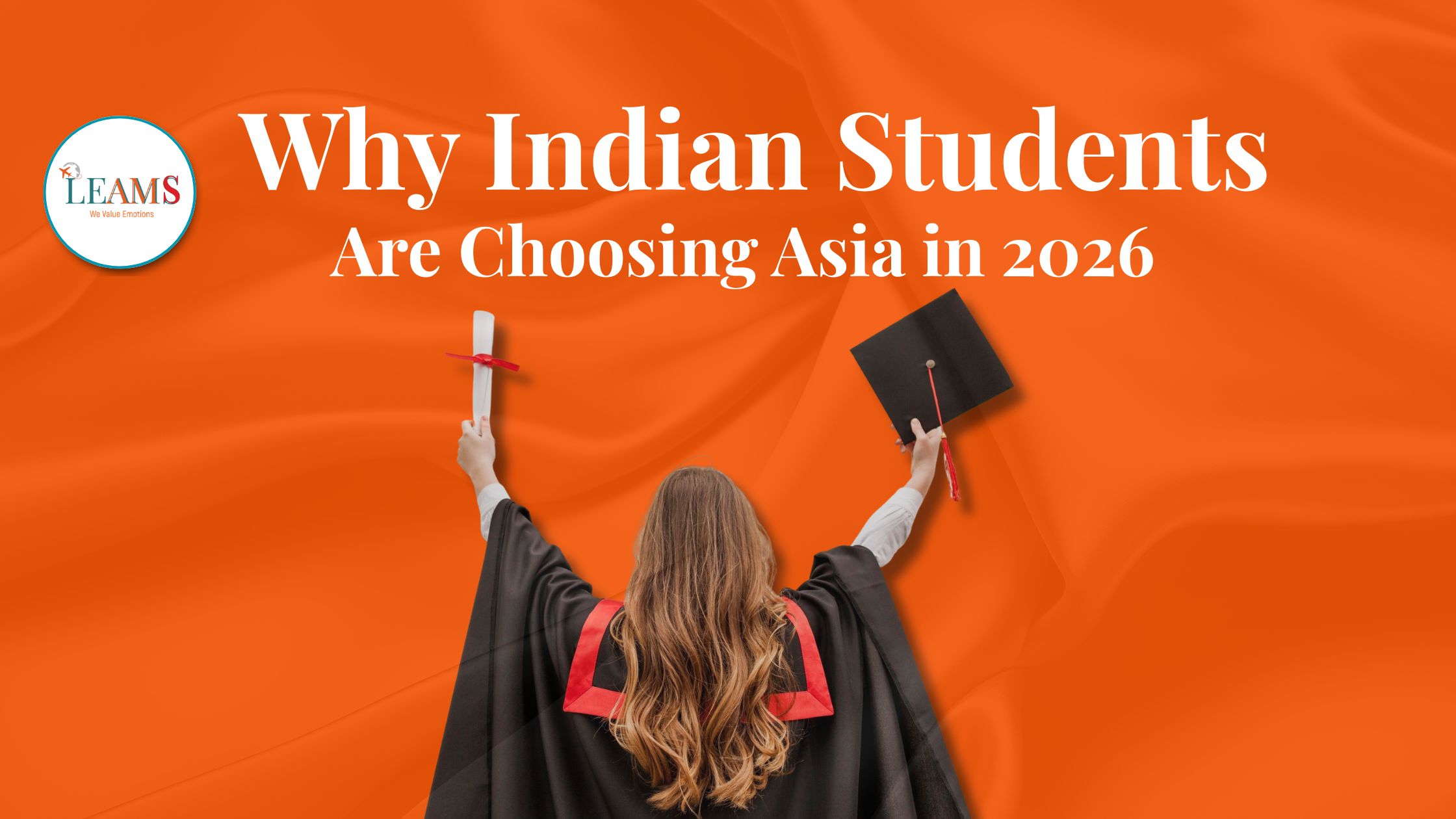

Why Indian Students Are Choosing Asia Over the West in 2026
Why Are Indian Students Choosing Asia Over the West? The Study Abroad Trend You Can't Ignore in 2026
Affordable degrees, world-class scholarships & booming career opportunities — discover why thousands of Indian students are choosing Asia over the West in 2026. Expert visa guidance inside.
The Great Asian Shift — What the Numbers Are Telling Us
Why Asia Makes Sense in 2026 — The Real Advantages
- Cost vs. quality: Annual tuition across China, Japan, and the Philippines ranges from ₹9–12 lakhs, compared to ₹25–60 lakhs in the West — with world-ranked universities like NUS, Tsinghua, and University of Tokyo delivering genuinely comparable academic outcomes.
- Fully-funded scholarships: Japan's MEXT, China's CSC, and South Korea's KGSP cover full tuition, accommodation, and monthly stipends of ₹35,000–₹1,00,000 — open to Indian nationals every year, with most seats going unfilled due to lack of awareness.
- ROI that actually makes sense: A complete medical degree in the Philippines costs ₹30–40 lakhs all-inclusive. The same degree at a private Indian college exceeds ₹80–100 lakhs. Global recognition is comparable; the financial burden is not.
- Career-defining advantages: Post-study work visas in Japan, South Korea, and Singapore enable legal international work experience. Graduating with Japanese, Korean, or Mandarin proficiency is a powerful differentiator in India's IT, manufacturing, and export sectors.
- Closer to home: Asian time zones sit just 2.5–3.5 hours ahead of India — making family calls, emergencies, and home visits far more manageable than studying in the US or Europe.
The Scholarships Most Indian Students Don't Know Exist
| Scholarship | What It Covers | Monthly Stipend (INR) | Open To |
| China CSC Scholarship | Full tuition + accommodation + stipend | ₹35,000–₹42,000 | Indian nationals |
| Japan MEXT Scholarship | Full tuition + living allowance | ₹82,000–₹1,00,000 | Indian nationals |
| South Korea KGSP | Full degree + language prep year | ₹57,000–₹95,000 | Indian nationals |
| Singapore MOE Tuition Grant | Partial tuition subsidy | N/A | All international students |
Your Country-by-Country Breakdown 2026
| Country | Top Courses | Key Attraction | Scholarship |
| China | MBBS, Engineering, Business | Cheapest MBBS globally, WHO-recognised institutions | CSC Scholarship (fully funded) |
| Singapore | Finance, Technology, MBA | NUS/NTU global rankings, English medium | MOE Tuition Grant |
| Japan | Engineering, Design, Research | Technology leadership, safe, part-time work rights | MEXT Scholarship |
| Malaysia | Medicine, Engineering, Hospitality | English language, affordable, Indian food widely available | Malaysia International Scholarship |
| Philippines | MBBS, Nursing, Tourism | Cheapest English-medium MBBS, US-pattern curriculum | University-level grants |
| South Korea | Technology, Business, Arts | K-culture boom, KGSP scholarship, global brands | KGSP (Korean Govt. Scholarship) |
| Thailand | Hospitality, Health Sciences | Tourism sector careers, low living cost | ASEAN scholarships available |
How Smart Indian Students Navigate the Asian Study Pathway
- Researching universities through QS rankings and YouTube vlogs from Indian students already studying in Asia.
- Verifying programme eligibility and English-medium availability
- Applying for government scholarships (CSC, MEXT, KGSP) well ahead of their individual deadlines.
- Working with a visa expert to ensure country-specific documentation is error-free.
- Completing pre-departure prep — forex, accommodation, and logistics — in the final 30 days before travel.
Challenges You Should Know — And How to Navigate Them Wisely
- Unrecognised universities — Always verify NMC, AIU, or international accreditation before applying.
- Language barrier — Daily life in Japan, South Korea, and China operates in the local language; language bridge courses help but require commitment.
- Visa documentation errors — The most common cause of rejections; entirely preventable with professional guidance.
- Financial planning gaps — Account for forex fluctuation, initial deposits, and money repatriation before departure.
Ready to Make Asia Your Study Destination?
The right guidance can mean the difference between a missed deadline and a fully-funded degree. Our immigration experts at LEAMSS have helped hundreds of Indian students secure student visas, scholarships, and admission offers across Japan, China, Singapore, Malaysia, South Korea, and the Philippines.
Book Your Free Study Abroad Consultation for 2026
Frequently Asked Questions (FAQs)
Q.1 Is an Asian university degree valid in India?
Q.2 Do I need to know the local language to study in Asia?
Q.3 How early should I start the application and visa process?
Ideally 10–12 months before your intended intake. Scholarship applications (CSC, MEXT, KGSP) typically open 8–10 months before the academic year. Visa processing takes an additional 4–8 weeks after university admission is confirmed.
Q.4 Can Indian students work part-time while studying in Asia?
Japan and South Korea permit international students to work part-time (up to 28 hours/week in Japan). Singapore allows part-time work in certain visa categories. Malaysia and China have more restrictions — always confirm the specific rules for your student visa type.
Q.5 Is studying in Asia safe for Indian students?
Countries like Japan, Singapore, and South Korea consistently rank among the world's safest for international students. Large Indian student communities in all major study destinations also provide a strong social safety net.
 Back to Home