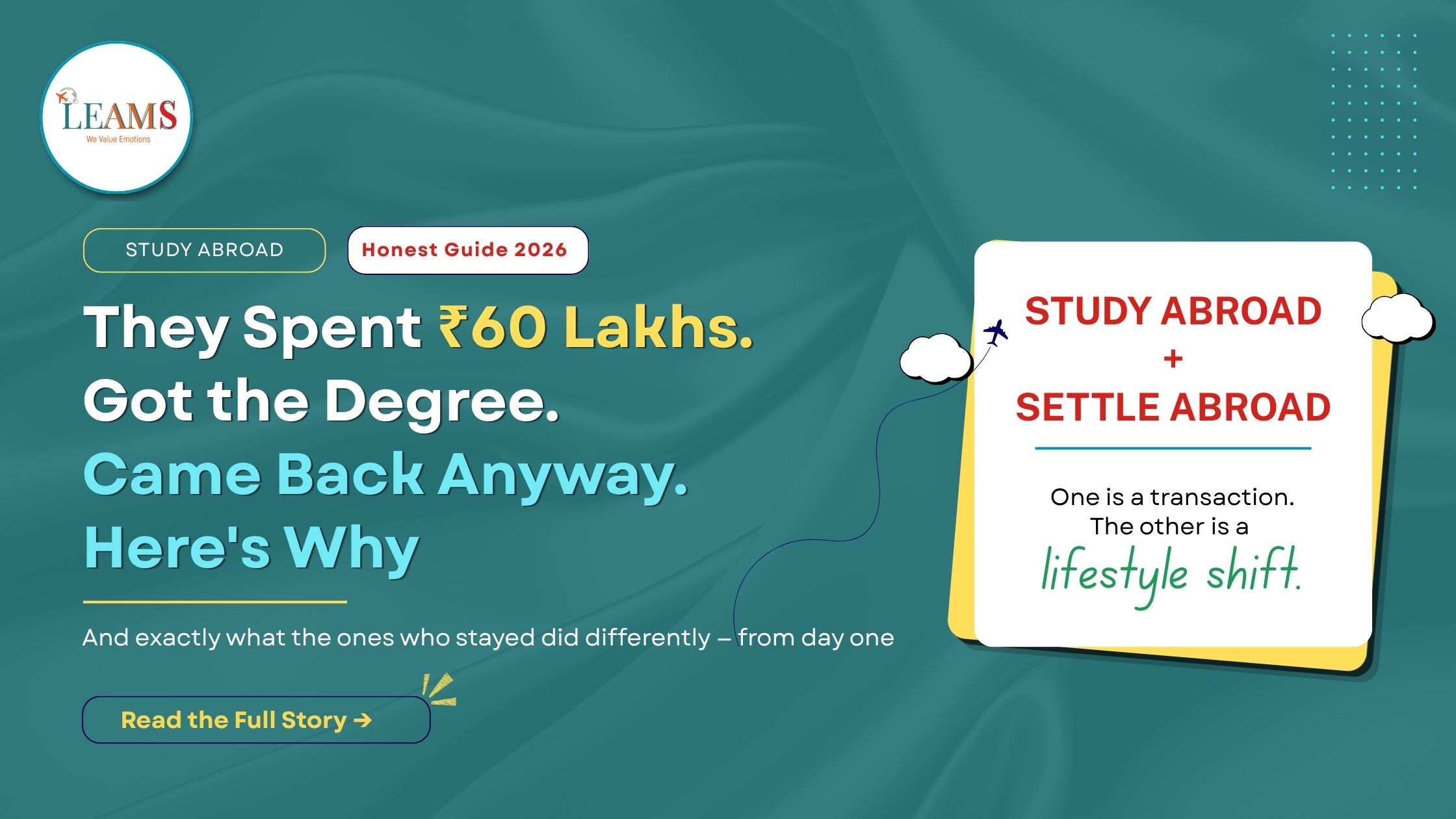

Why Indians Return After Studying Abroad — And What the Ones Who Stayed Did Differently
Why Indians Return After Studying Abroad — And What Separates Them From Those Who Build a Life There
Every year, over 13 lakh Indian students board flights to universities abroad. Most leave convinced they will stay. A significant number are back within two years. The question every Indian family is asking — but rarely out loud — is this: why do so many Indians return after studying abroad, even with a degree, even after spending ₹40–80 lakhs? The answer is not one thing. It is six. And understanding them before you leave is the difference between a strategy and a gamble. This guide does not sell you a dream. It tells you what actually happens — and exactly what the students who stayed did differently.
The 6 Real Reasons Why Indians Return After Studying Abroad
Let's be honest about something: a lot of returns happen not because India was calling — but because abroad didn't go as planned. Understanding the real reasons helps you prepare better.
They Chose a Country or Course for the Wrong Reasons
Friends' advice, a counselor's pitch, or a university brochure — that's how many students make a six-figure decision. Nobody checked what jobs were actually hiring, what the post-study visa rules looked like, or what rent cost in that city. When reality hits, it hits hard.
The Money Ran Out Faster Than Expected
Tuition gets budgeted. Groceries, rent, transport, and health insurance in a foreign country usually don't — not honestly, anyway. Many families drain their savings within the first year. At that point, the decision to return makes itself.
The Degree Didn't Lead to a Job
This one hurts the most. A Master's from a mid-tier university, in a field with low local demand, won't hand you an offer letter. Employers abroad want local experience, strong communication, and a network — none of which a classroom gives you.
The PR Path Keeps Changing
Canada, Australia, the UK — all three have quietly tightened their permanent residency rules over the past few years. Points systems, occupation lists, state nomination caps — the route got longer and less certain. Students who had a plan found the plan no longer existed.
Loneliness Is Real, and It's Heavy
This doesn't get talked about enough. Living in a country with no family, little community, and an unfamiliar culture is genuinely difficult. The pressure to justify the sacrifice — emotionally and financially — wears people down. Coming home is often the right call, even when it doesn't feel like one.
Family — the Reason That Doesn't Need an Explanation
A parent's health. A sibling who needs support. Or simply the realization that being thousands of kilometers away from everyone you love isn't the life you want. That's a valid reason. It deserves more respect than it gets.
Real-World Example
Rohan left for a Master's in IT Management in Canada in 2022, expecting to land a tech job and start his PR process within a year. Post-COVID layoffs hit the Canadian tech sector hard. He spent 14 months applying, took a warehouse job to survive, and eventually returned to Pune — where he joined a global tech firm and was promoted within eight months. His story isn't a failure. His story is redirection.
Why Others Successfully Stay and Settle Abroad
They Chose Their Country and Course Strategically
They Built Skills That Go Beyond a Degree
They Adapted to How Work Actually Functions There
They Started PR Planning From Day One
They Stayed Flexible When Plans Changed
They Planned Their Finances Like It Was a 2-Year Project
Real-World Example
Expectation vs. Reality: The Honest Comparison
| Abroad Stages | Expectation | Reality (2025–26) |
| Job after graduation | Immediate, based on degree | Takes 6–18 months; highly competitive |
| PR timeline | 2–3 years, straightforward | 3–7 years, unpredictable, rule changes |
| Social life abroad | Easy to make friends, vibrant culture | Loneliness is real; community takes effort |
| Cost of living | Manageable with part-time work | Often 60–80% of income in most cities |
| Value of degree | Opens all doors globally | Matters less than experience + network |
Before You Book That Flight — 7 Questions Every Indian Student Must Answer Honestly
- Do I know the specific PR pathway for my chosen country and occupation?
- Have I researched actual job demand for my course in that country's job market?
- Do I have 18–24 months of living expenses saved beyond tuition?
- Am I prepared for the emotional reality of living alone far from family?
- Do I have a Plan B if the PR pathway changes while I'm there?
- Is my motivation to settle abroad, or just to have the option?
- Am I willing to take any job for 1–2 years to build local experience?
Returning to India After Studying Abroad Is Not Failure — And It Is Time We Said That Loudly
The narrative that "coming back means you didn't make it" is one of the most damaging myths in Indian middle-class culture. It needs to stop. India in 2026 is not the India of 2005. Opportunities in tech, finance, healthcare, and entrepreneurship are genuinely competitive with what many Western countries offer — especially when you factor in cost of living, purchasing power, and proximity to family. Many Indians who return bring back skills, global exposure, and a perspective that makes them considerably more valuable in the Indian job market than they were before they left. That's a return on investment — just not the one they originally planned for. The decision to return or stay should be driven by data, clarity, and honest self-assessment — not by fear of judgment, pressure from family, or sunk cost fallacy.
Stay or Return — The Only Question That Actually Matters Is: Did You Decide With Full Information?
Check If Your Profile Is PR-Ready — Free Evaluation
(FAQs) Why Indians return after studying abroad :-
Q.1 Is it worth studying abroad for PR in 2026?
Yes — but only if you treat it as a long-term strategy, not a guaranteed outcome. PR pathways in countries like Canada, Australia, and the UK have become more competitive and unpredictable. Students who research job demand, choose the right course, and plan finances realistically still succeed. Others struggle due to poor planning.
Q.2 Which countries are easiest for Indians to get PR after studying?
There is no “easy” country anymore. However, countries like Canada and Australia still offer structured PR pathways — but only for in-demand occupations and well-planned profiles. Smaller regions, state nominations, and strategic course selection can significantly improve your chances.
Q.3 How often do PR rules change in countries like Canada and Australia?
PR rules can change every year or even multiple times within a year. Points thresholds, occupation lists, and quotas are regularly updated based on economic needs.
PR rules can change every year or even multiple times within a year. Points thresholds, occupation lists, and quotas are regularly updated based on economic needs.
Q.4 Is returning to India after studying abroad a bad decision?
No — it can actually be a smart move. India’s job market in 2026 offers strong opportunities, especially for candidates with international exposure. Many returnees find better career growth, higher purchasing power, and improved work-life balance compared to staying abroad under uncertain conditions.
No — it can actually be a smart move. India’s job market in 2026 offers strong opportunities, especially for candidates with international exposure. Many returnees find better career growth, higher purchasing power, and improved work-life balance compared to staying abroad under uncertain conditions.
 Back to Home